A Dot a Day Keeps the Clutter Away
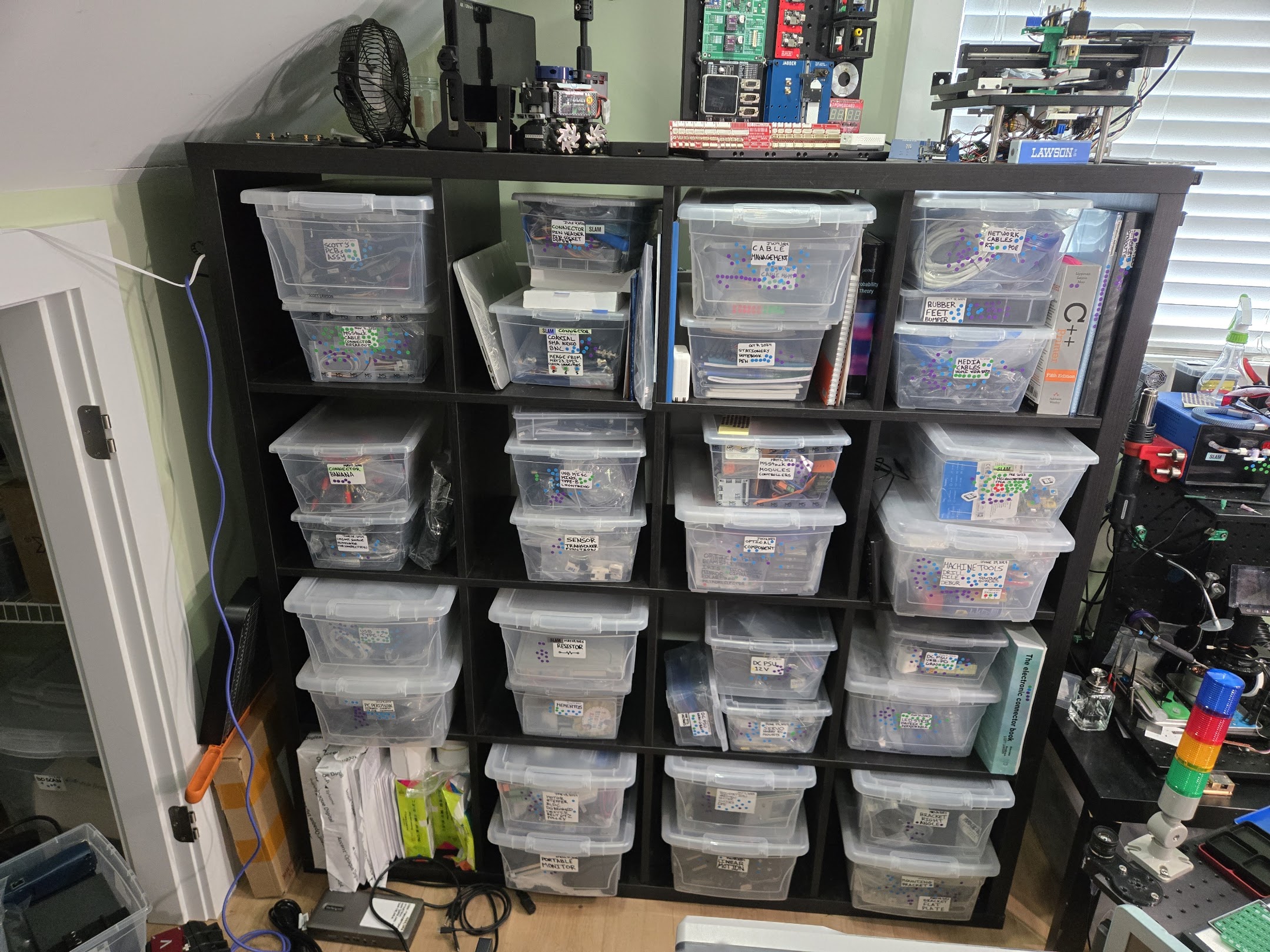
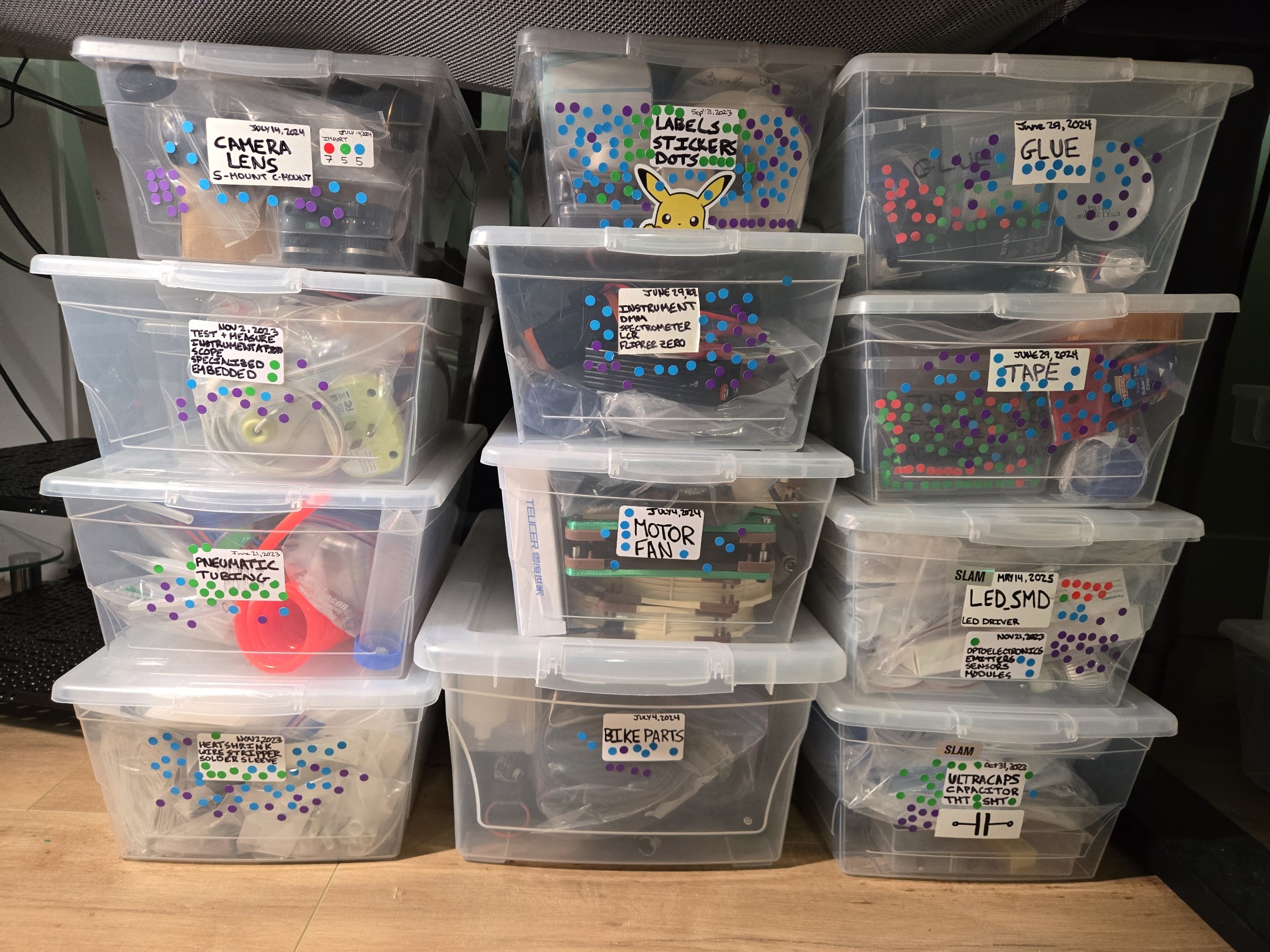
Walk into my lab and the first thing you'll notice is the dots. The walls are lined with clear boxes, each one labeled, dated, and covered in dot stickers. Some boxes are buried in dots of every color. Others have a few. Others are bare. You don't know what they mean yet, but you can see the pattern. That's the system. It costs three dollars, has no software, and I've been using it for four years.
The Parts Problem
I've been collecting electronic components since university in 2011. Resistors, capacitors, microcontrollers, motors, drivers, DC-DC converters, displays, amplifiers, servos, LEDs, connectors. The usual trajectory of someone who keeps finding new projects. At first, my collection was small. A few toolboxes held everything. Then I graduated, kicked it into high gear, and by 2017 the collection had outgrown every container I owned.
I was stuck in an awkward middle ground. Too many parts for no system at all, but I was still one person. I didn't have the problems that DigiKey or Mouser have, where they need barcodes on everything and a vast computerized inventory. I was looking for something simple that made sense for the scale I was working at.
Out of Sight, Out of Mind
The first thing I did was get rid of every opaque container I owned. Every toolbox, every parts organizer with little pockets, anything I couldn't see through. I replaced everything with standardized 4L clear boxes from Superstore.
I learned this lesson early and it stuck: if I can't see what's in a box, I forget it exists. Clear boxes fixed that. I started sorting parts into categories that emerged naturally over time. A box for capacitors, a box for resistors, a box for motors, a box for LEDs.
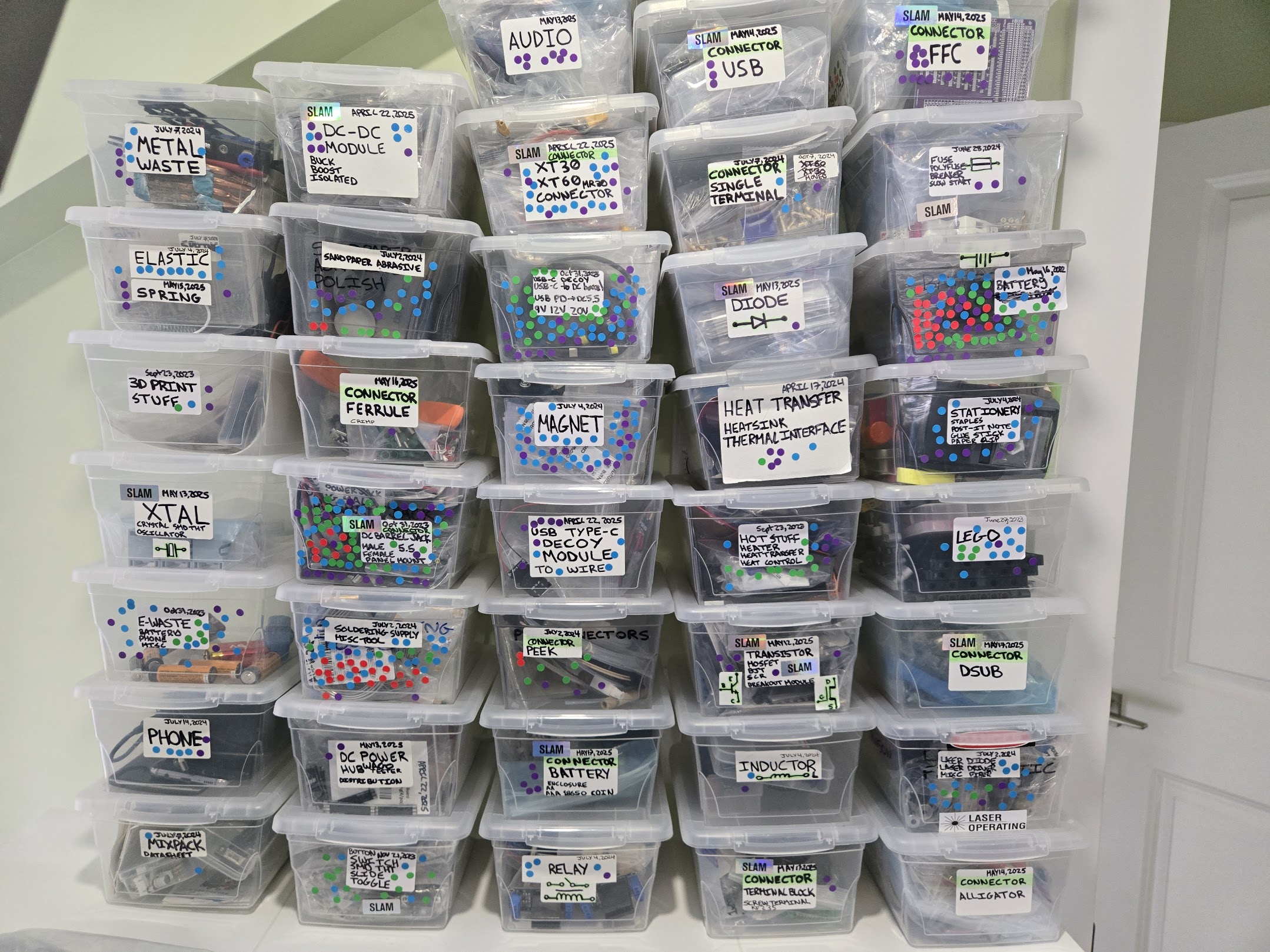
The parts organizers with individual pockets were the first to go. They seem like a good idea when your collection is small, but as you keep adding parts, the fixed compartments become a problem. Components outgrow the pockets, and eventually you run out of pockets. The whole organizer becomes a constraint instead of solving the problem. Clear boxes don't have this problem and the system can scale by simply buying more boxes.
The Intuition Gap
As I worked on projects over months and years, I started to build an intuition about which boxes I was reaching for and which ones were collecting dust. My box of batteries was always on my desk. My box of fuses hadn't been opened in my entire memory. But it was just a feeling. I couldn't quantify it. I couldn't tell you whether I opened my LED box twenty times last year or five. My memory is not good enough to track usage patterns across years of different projects.
And meanwhile, I had a constant influx of new parts. I'd work on an LED project, then move on to something that needed pneumatic components, so I'd order pumps and fittings. Then I'd get interested in piezoelectrics and order a bunch of piezos. Parts kept being added to my collection but my available space did not increase.
As Kirchhoff's current law states, the current into a node must equal the current out. If I kept acquiring parts at this pace without getting rid of anything, I would eventually drown. I needed a way to figure out what was worth keeping and what should go, so the system can reach a steady state.
I considered RFID tags, barcode scanners, a spreadsheet. All of them felt like too much. Then I found the simplest possible solution on AliExpress for a few dollars.
One Dot Per Box Per Day
I ordered sheets of colored dot stickers. Six millimeters in diameter. Hundreds of them for almost nothing.
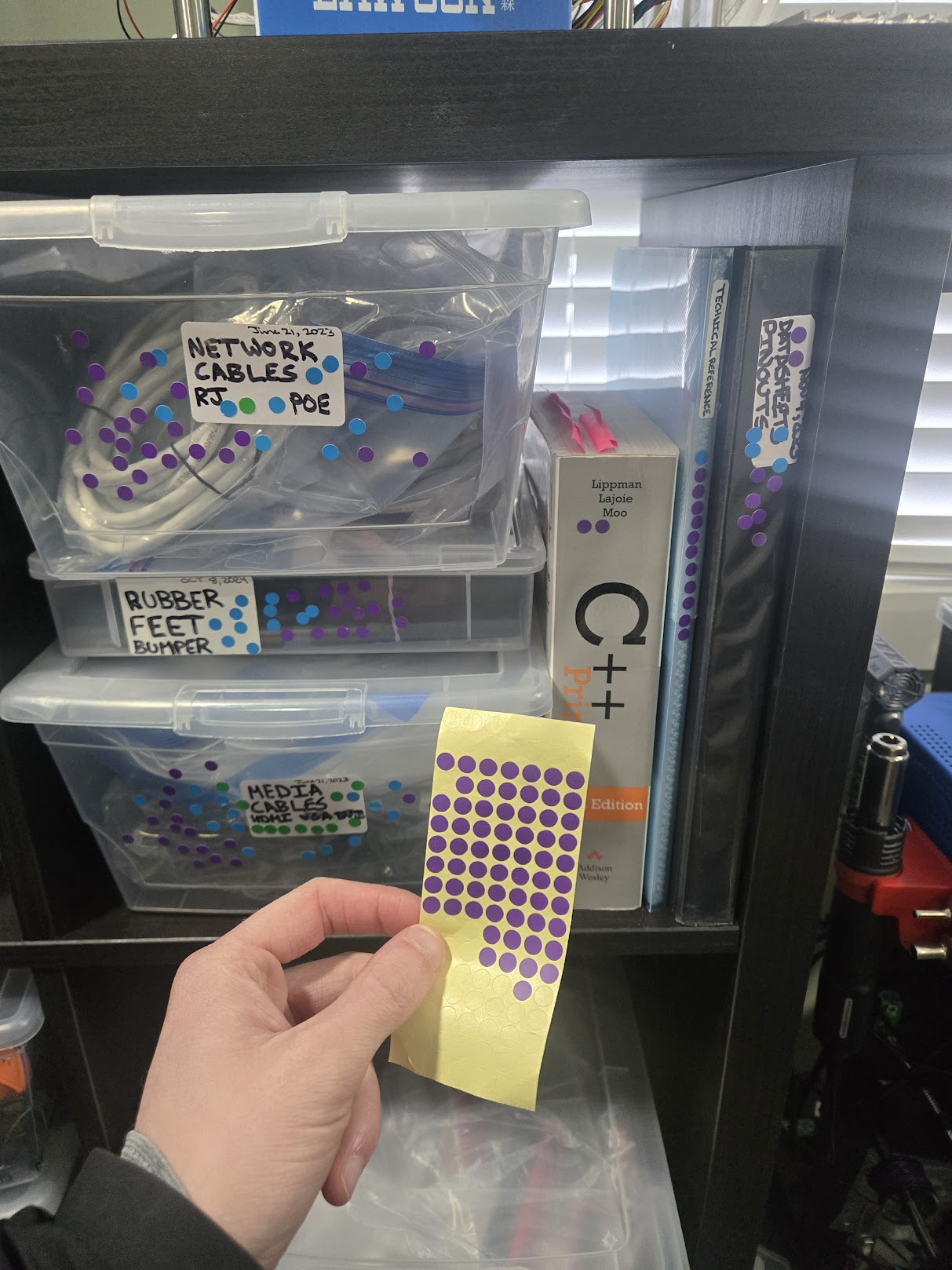
Every box already had a label on the front with its category and the date I created the box. The new rule was simple: every time I open a box, I place one colored dot sticker near the label. That's it. Use the box, add a dot.
I quickly realized that on days when I'm deep in a project, I might open the same box five or ten times. Tracking every single opening would be noise. So I refined the rule: one dot per box per day. If I open my LED box ten times on a Tuesday, it still gets one dot. What I actually care about is how many days per year I use a box.
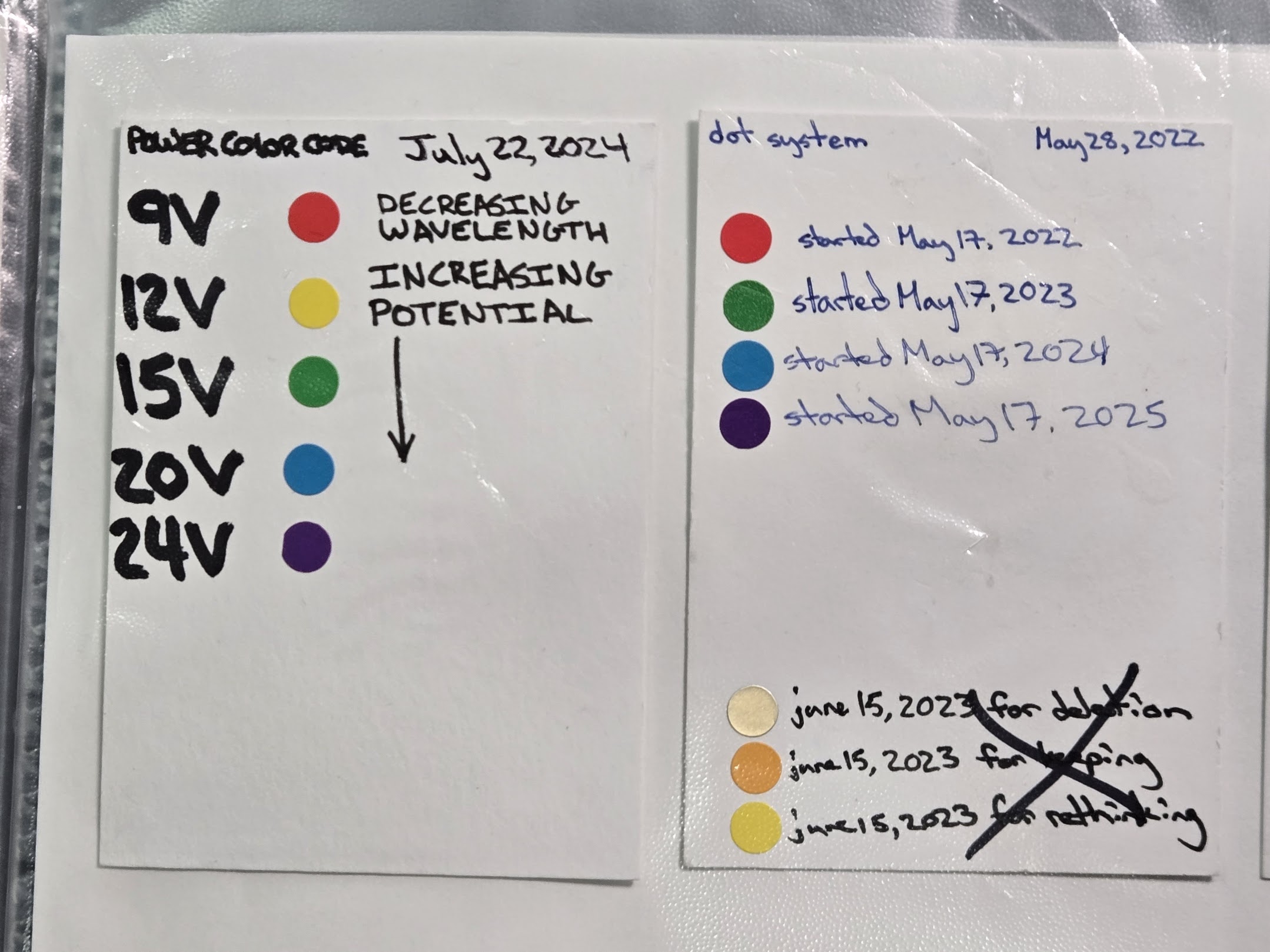
Then, because I had all of these different colors, I decided to assign one color per year. I have over ten colors, so the system works for at least a decade. A piece of paper in my technical reference binder maps each color to its year so I never forget.
That's the entire system. Sticker sheets cost a few dollars, and there is no database, no server, and no app. The system that works is the one simple enough to do every day for four years.
Sticking With Stickers
I wondered at first whether I'd actually keep up with it. Would I forget? Would it be annoying to find a sticker sheet every time I opened a box?
Both problems solved themselves. I keep sheets of stickers in multiple locations around the lab, so I'm always within arm's reach of one. Applying a dot is muscle memory at this point. And forgetting turns out to be hard, because the dots are their own reminder. Even if the box I just opened has no dots, the neighboring boxes are covered in them. The visual prompt is everywhere.
Visitors always ask about the dots as they're impossible to miss. When I explain the system and show how I add a dot whenever I use a box, there's usually a pause, and then it clicks. A single dotted box doesn't mean much on its own. It's seeing a whole shelf of them, some covered and some bare, that makes it obvious this is a system.
What the Dots Revealed
After four years, the data is hard to argue with. Walk into my lab and you can read the shelves like a dashboard. Some boxes are covered in dots of every color, used year after year, project after project. Others have a cluster of one color from a single project and nothing since. Others are completely bare.
The biggest surprise was which parts turned out to be essential. It wasn't sensors, even though I had many different kinds, it wasn't specialized components or "cool" things. The most-dotted boxes are:
Glue. Tape. Stickers. General-purpose connectors. Batteries. Magnets. LEDs. DC-DC power converters. USB-C to barrel jack cables. Capacitors. Resistors. Mechanical tools like files, drill bits, and cutters. Calipers. SD cards and USB drives. Rubber feet. Fasteners.
In retrospect, it makes a lot of sense. All of these things are cross-cutting concerns. Power components like batteries, DC-DC converters, and USB-C cables appear in nearly every project. Connection components like glue, tape, magnets, fasteners, and general-purpose connectors bridge different systems together. Rubber feet show up whenever anything needs to sit on a desk. These aren't the exciting parts. They're the common components that nearly every project shares.
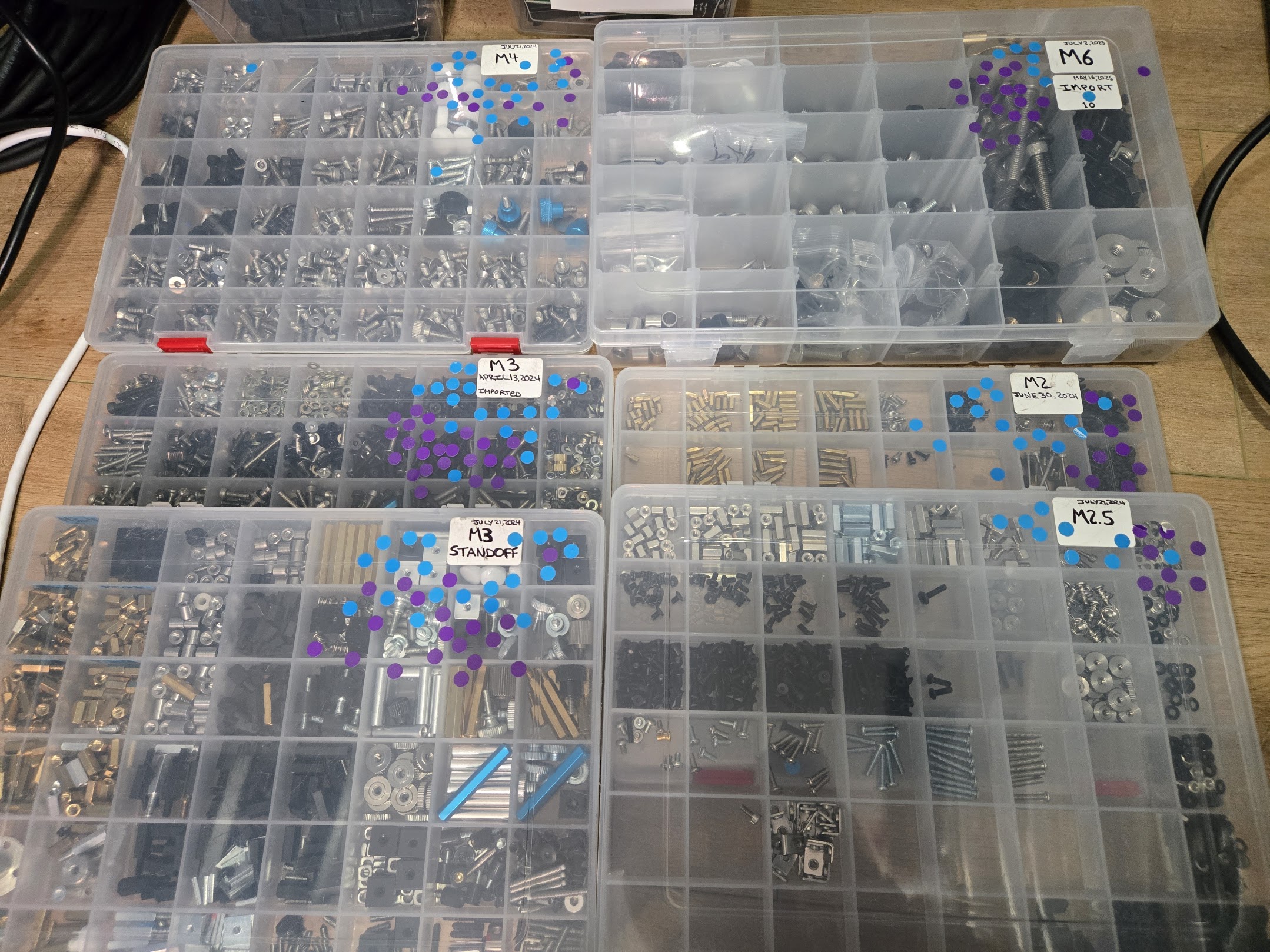
Even within a category, the dots reveal patterns. My metric fastener boxes tell a clear story: M3 is by far the most used, with two boxes dedicated to it. M6 is next because I use it for optical breadboards. M2.5 barely gets dotted because it's specialized for things like Raspberry Pi mounting holes.
Meanwhile, sensors barely got dotted. Fuses, piezoelectric modules, specialized connectors: too application-specific to be core. Discrete LCD modules went unused after I started buying microcontrollers with integrated displays and buttons. I use capacitors and resistors constantly, but inductors got used maybe twice in four years.
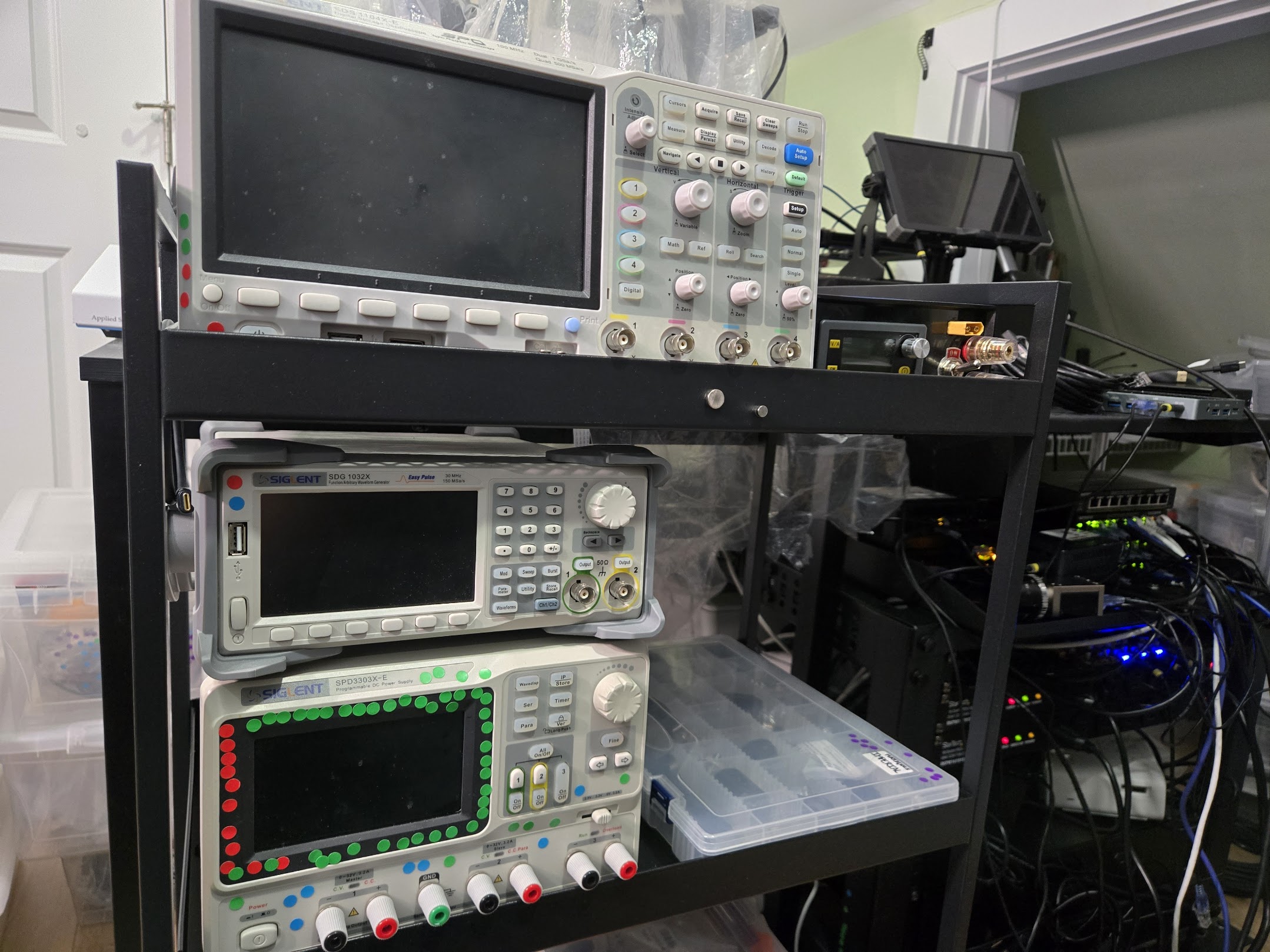
And then there were the tools I thought were essential. My oscilloscope, function generator, and logic analyzer are commonly recommended as must-have tools for any electronics lab. Five dots on the oscilloscope in four years. I was genuinely surprised. I know for some people, in fields like RF, these tools are indispensable. But in my work, they're not. I wouldn't have had the confidence to say that without the data.
Bags Are Directories
As I consolidated boxes and introduced larger sizes, finding specific parts inside a box became frustrating. I went through three generations of bags: ziplock bags from the grocery store, then clear logo-free bags from AliExpress (which wrinkled), then thick-walled clear bags that were more expensive but worth it. If you're starting from scratch, skip the first two and go straight to thick clear bags.
I started seeing the whole system like a file system on a computer. Boxes are top-level directories. Bags are subdirectories. Parts are files. Bags can contain other bags. The Johnny Decimal system recommends no more than ten items per category. I don't follow that rigidly, but I agree with the spirit: inside a box, aim for roughly ten bags. Inside a bag, aim for roughly ten sub-bags max. When things get too crowded, subdivide.
Every bag gets a handwritten label with its contents and the current date. I put dates on everything. Time turns out to be a great universal organizer, just like how a photo collection is wonderfully organized by date more than by any other single dimension.
Hot, Warm, and Cold
Eventually my lab overflowed and I had to make real decisions about what stays and what goes. The dots helped me make those decisions.
I set up three tiers. My most-dotted boxes stay within fifteen feet of my desk. Less frequent boxes go in a closet in the lab. Boxes with no dots for a long time go to a separate storage shed outside of my lab, which I think of as "cold storage".
Cold storage examples: a box of liquid pumps (ink pumps, peristaltic pumps, air pumps). A box of piezo actuators and piezo motors. I find piezos fascinating, but I've reluctantly come to admit over time that they're just not that useful to me. A set of Parker linear motors I bought as lab surplus on eBay. Cool hardware, but the software for the ViX servo drives only works on Windows XP, and I didn't have much need for linear motors. Zero dots for two years and moved it to the shed.
Sometimes things come back. When I started building a pick-and-place machine, my pneumatic components came right out of cold storage. That's not a failure, I expect that some things will come back, just not very many things. Cold storage is like a staging area, not a graveyard. If a box sits there long enough untouched, the next step is donating or selling.
This closes a loop. When you constantly acquire new parts but have limited space, you need a system that tells you what should go out the door as new things come in. The dots provide that signal. A lot of people hoard things they don't need. Seeing clear evidence that a box has zero dots is what helps me overcome the hesitation to finally let go of it.
Dot It Yourself
Principles I've learned over four years of the dot system.
Clear boxes, same size and shape. Having a common form factor is like having a common software interface. Lids become interchangeable. If a box breaks you can replace it. You'll probably need a few different sizes. Pick sizes where each jump is roughly double the last. I use four sizes total.
Labels on the front, not the lid. You will regret lid labels the moment you stack boxes.
Date everything. Every label, every bag. It feels unnecessary at first but it pays off over time. It's also a kind of time capsule for yourself.
Thick clear bags. Take the time to label them. A permanent marker works fine. I use name tag sized white labels.
Keep sticker sheets near your boxes. If applying a dot takes more than two seconds, you'll stop doing it. I put sticker sheets in half a dozen places around the lab near my boxes.
Everything needs a home. If only some things are in the system, the value is diminished. Everything you want to track needs to belong somewhere.
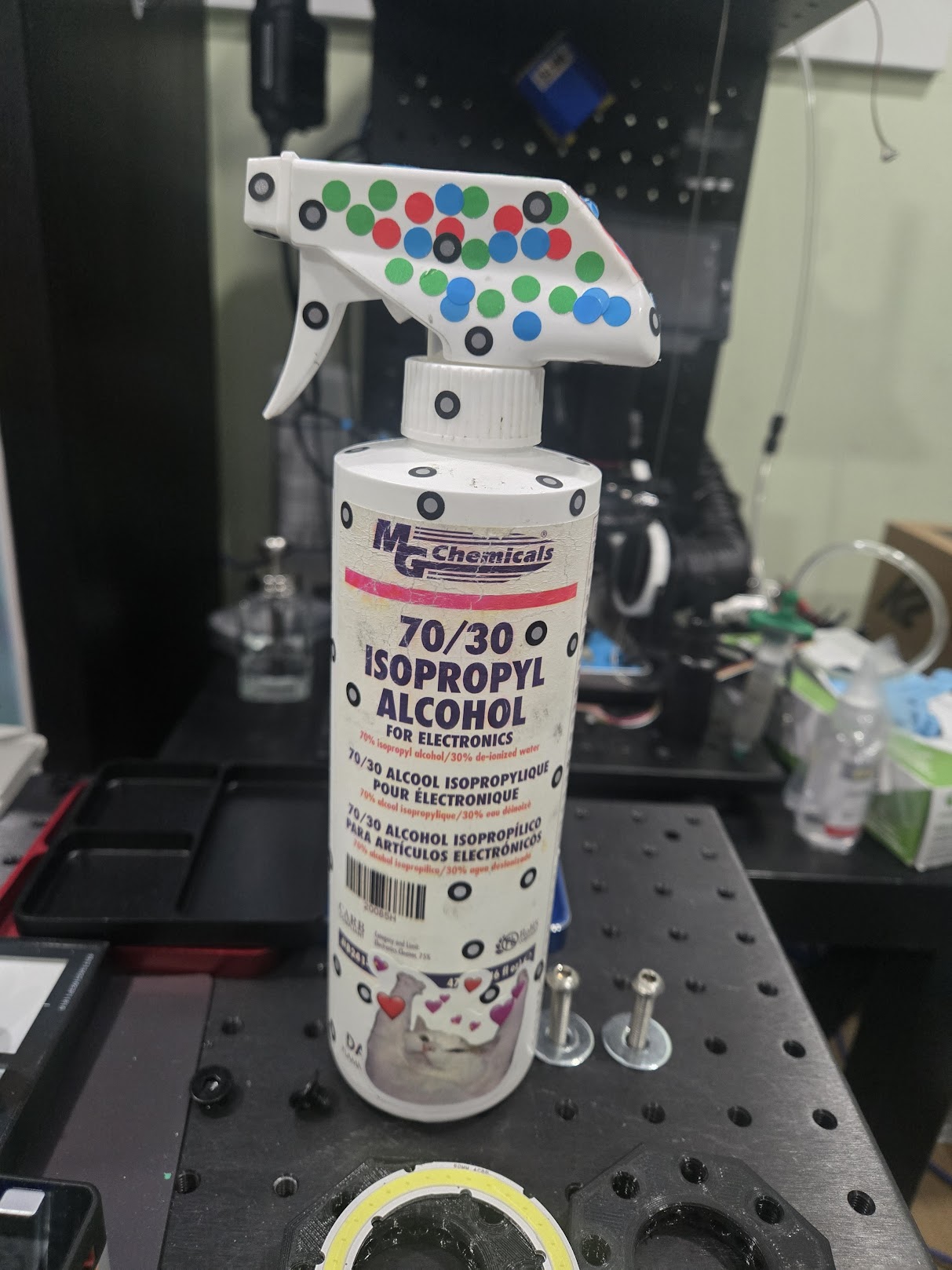
Don't dot the obvious. I put dots on my soldering iron, calipers, and isopropyl alcohol bottle but it was pointless. I already knew these tools were cornerstones of my lab. The dots are most valuable for things where usage is genuinely ambiguous.
Curate categories. A box of random miscellaneous parts teaches you nothing. Boxes of parts that are used together yield high-quality signal.
And then give it time. A year in, you'll start seeing patterns. Two years in, you'll trust them enough to know how to refactor your collection.
The dot system doesn't have to be figured out all at once. Mine evolved through three generations of bags and two major reorganizations. My interests changed, my domain of expertise grew, my collection expanded. The system evolved along with me. I like that it is a living, fluid system.
Walk into my lab and the dots will tell you everything you need to know. They told me too. It just took four years and a $3 pack of stickers. I'm still adding dots.